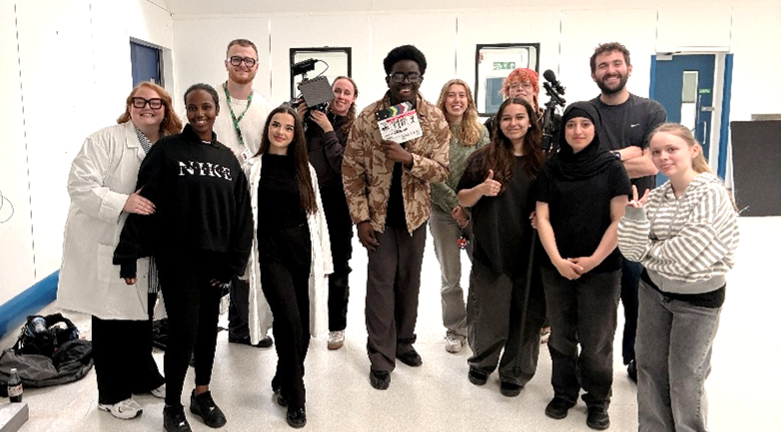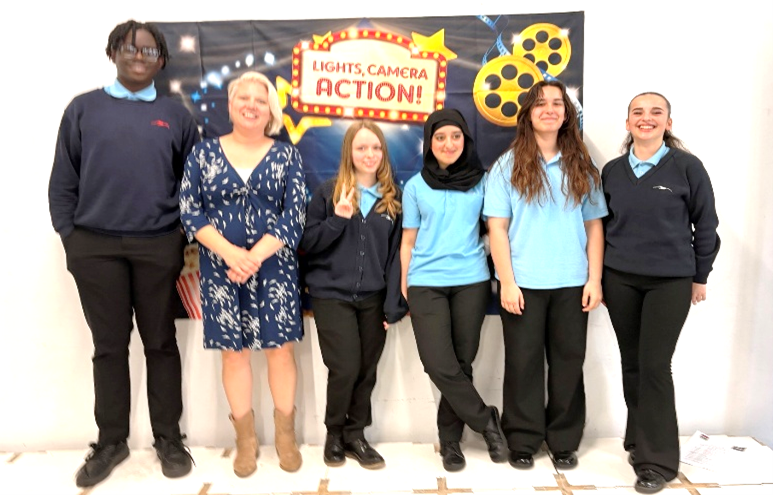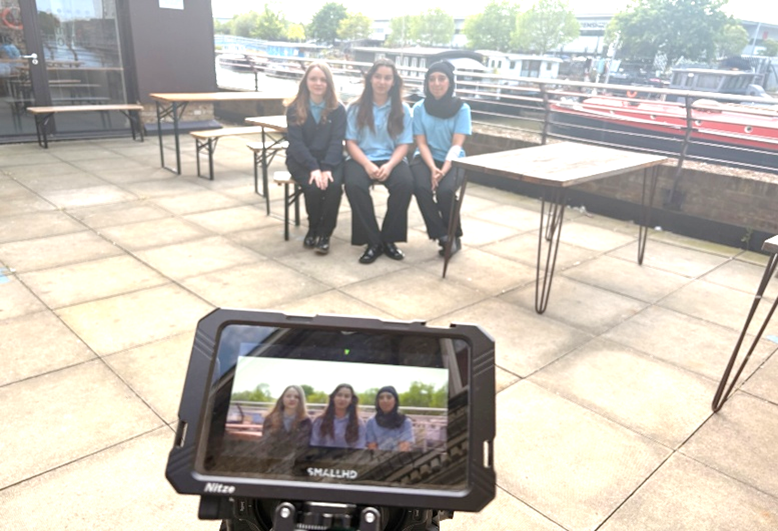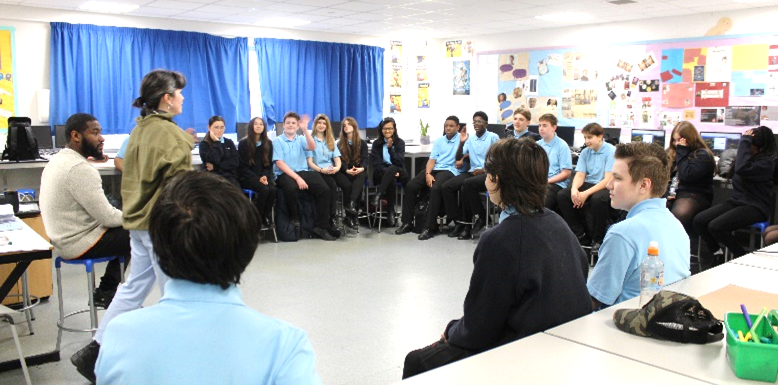

In the Media Studies department, we aim to equip students with the skills and understanding which will help them to understand the messages being sent – and often manipulated – by the mass media. As such, we value a rigorous analytical approach to the subject, allowing students to understand the effects of the media on society. This approach is based on the fundamental values of rigour, hard work, and a strict adherence to deadlines, all of which allow our students to achieve their potential in the subject.
Curriculum
Key Stage 4
Component 1: Exploring the Media
Written examination: 1 hour 30 minutes
40% of qualification
Section A: Exploring Media Language and Representation
This section assesses media language and representation in relation to two of the following print media forms: magazines, marketing (film posters), newspapers, or print advertisements.
There are two questions in this section:
- Part (a) – One question assessing media language in relation to one set product (reference to relevant contexts may be required)
- Part (b) – One two-part question assessing representation in relation to one set product and one unseen resource in the same media form.
Part (a) is based on media contexts. Part (b) requires comparison through an extended response.
Section B: Exploring Media Industries and Audiences
This section assesses two of the following media forms: film, newspapers, radio, video games.
It includes:
- One stepped question on media industries
- One stepped question on audiences.
Component 2: Understanding Media Forms and Products
Written examination: 1 hour 30 minutes
30% of qualification
This component assesses all areas of the theoretical framework and contexts of the media in relation to television and music.
Section A: Television
- One question on either media language or representation, which will be based on an extract from one of the set television programme episodes to be viewed in the examination (reference to relevant contexts may be required)
- One question on media industries, audiences or media contexts.
Section B: Music (music videos and online media)
- One question on either media language or representation (reference to relevant contexts may be required)
- One question on media industries, audiences or media contexts.
Component 3: Creating Media Products
Non-exam assessment
30% of qualification
An individual media production for an intended audience in response to a choice of briefs set by Eduqas, applying knowledge and understanding of media language and representation.
Key Stage 5
Component 1: Media Products, Industries and Audiences
Written examination: 2 hours 15 minutes
35% of qualification
The examination assesses media language, representation, media industries, audiences and media contexts. It consists of two sections:
Section A: Analysing Media Language and Representation
This section assesses media language and representation in relation to two of the following media forms: advertising, marketing, music video or newspapers.
There are two questions in this section:
- One question assessing media language in relation to an unseen audio-visual or print resource.
- One extended response comparison question assessing representation in one set product and an unseen audio-visual or print resource in relation to media contexts.
Section B: Understanding Media Industries and Audiences
This section assesses two of the following media forms – advertising, marketing, film, newspapers, radio, video games – and media contexts.
It includes:
- One stepped question on media industries.
- One stepped question on audiences.
Component 2: Media Forms and Products in Depth
Written examination: 2 hours 30 minutes
35% of qualification
The examination assesses media language, representation, media industries, audiences and media contexts. It consists of three sections:
Section A – Television in the Global Age
There will be one two-part question or one extended response question.
Section B – Magazines: Mainstream and Alternative Media
There will be one two-part question or one extended response question.
Section C – Media in the Online Age
There will be one two-part question or one extended response question.
Component 3: Cross-Media Production
Non exam assessment
30% of qualification
An individual cross-media production based on two forms in response to a choice of briefs set by Eduqas, applying knowledge and understanding of the theoretical framework and digital convergence.
Careers and further study
A-Level Media Studies is an industry-recognised qualification, and so offers students the chance to go straight into employment in the industry. It is also a subject which is highly compatible with many others in the curriculum because of the training it provides in independent and critical thinking and analysis.
Like any other GCSE, AS, or A Level course, Media Studies requires students to work in their own time to reinforce what they have learned in class. At GCSE level, students should expect to receive around an hour of homework per week. At AS and A Level, students are expected to be doing around five hours of independent work every week for the subject. In most cases, this homework will take the form of structured tasks set by the classroom teacher. However, in these Media Studies courses there is also the opportunity to complete aspects of the coursework assignments outside school hours, meaning that students are not restricted by the school setting when making film or other media. In addition to the work set, students are also expected to keep up-to-date with developments in the media – useful background knowledge can be built up by reading newspapers and magazines, and watching TV and film critically.
Ellie Lapping: “I will never forget my Media lessons. I feel I have learnt so much and that the Media course not only helped me gain confidence and enthusiasm for this brilliant subject, it also helped shape my future. I am so happy studying television production at Ravensbourne, I know I am; where I want to be, and that is because of A Level Media.”
Enrichment
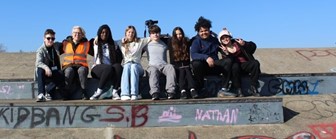
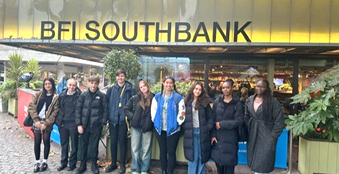
There are many opportunities to develop and use Media skills at JRCS. Students can get involved in projects throughout the school year, from filming the school play to making videos for lessons.
Marking Policy
At the core of our approach to marking at JRCS is task marking.
In non-practical subjects one substantial piece of work will be task marked at least once every eight hours of teaching. Students will respond to the tasks and they will be checked by staff. In between that time students’ work may be peer or self-assessed or briefly checked by staff.
It is likely the same piece of work will be assessed for literacy. Staff will mark work using the literacy marking code:
| Sp | spelling mistake |
| P | punctuation mark missing or incorrectly used |
| Voc | incorrect use of vocabulary |
| ^ | word missed out of sentence |
| ~ | unclear meaning or grammar within a sentence |
| // | new paragraph required |
| CL | capital letter error |
Levelling and Assessment
KS3
To develop a growth mindset and reflect ‘life after levels’ work in KS3 books will not usually be levelled; assessment will be formative and highlight how students can improve. Students will record areas of strength and development on their ‘reflection sheets’ which will be at the front or back of the book. At the end of each term a level is reported for students in each subject, which reflects all their work over that term. These are found on students’ pale yellow progress cards, which are stuck into their planners. These cards show students whether they are in line to meet their end of key stage target. With the move away from National Curriculum levels, the school is trialling a new ‘skills thermometer’ and 1 to 9 levelling in English. Other KS3 subjects will be using NC levels for the remainder of this year.
KS4
KS4 practice exam questions and mock exams are likely to be graded. This work might not be in student books. Students will record grades and areas of strength and development in their ‘reflection sheets’ which will be at the front or back of the book. All students receive an attainment and predicted grade at the end of each term. These are found on their pale yellow progress cards, which are stuck into their planners. These cards show students whether they are in line to meet their end of key stage target.
KS5
At KS5 students take a series of VIMAs (Sixth Form Milestone Assessments) during their course. Students receive developmental comments to help them improve their work. Each VIMA result includes four parts: the grade for that assessment, a comparison of the grade with their expected progress grade (EPG), a Learning Capability mark and a prediction of their end of year grade (PEG). The outcomes of these assessments and other graded work will be in student folders. They are also sent home to parents. A summary of VIMA marks and the students’ expected progress grade is also recorded in their planner.
A marks and the students’ expected progress grade is also recorded in their planner.