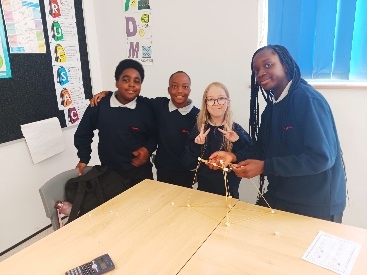

The JRCS Maths Department is aims to promote quality teaching and learning and have high expectations of students. We produce very good results for our students. At JRCS we aim to make Maths enjoyable, exciting and a worthwhile experience for all students. We follow a mastery approach; meaning students are taught fewer topics each year, with an aim to develop a deeper understanding. This allows students to apply the knowledge they have gained to unfamiliar contexts.
Curriculum
Key Stage 3
Our focus at KS3 is to lay the foundations of deep mathematical knowledge that will allow our pupils to thrive in their GCSE exams and be numerate in a society that increasingly demands that people be comfortable with numbers. We aim to achieve this through a curriculum and practice that uses the latest research on how to increase fluency, understanding and recall in maths. We also hope it increases engagement and a love of mathematics. To achieve this, we believe in teaching it right the first time. With this in mind, we have consistent, well-thought-out methods of instruction that all our teachers (who are all maths specialists) design and then follow. Second, we use materials developed by White Rose maths which emphasise the use of manipulatives and visual cues to help our pupils deepen their understanding of mathematical concepts. Third, we follow a scheme of work that emphasises both recall and understanding. This is achieved with use of the following strategies:
- We begin our lessons with a short review of previous learning as this strengthens previous learning and improves recall.
- We present new material in small, accessible steps, and then assist our pupils as they practice this new knowledge.
- We ask a large number of questions and check the understanding of all our pupils. The questions help our pupils practice their new learning and make connections with previous material.
- We provide clear modelling so pupils know what is expected of them and should never feel that they cannot tackle a question.
- We constantly check on pupils’ understanding so that we can quickly deal with any misconceptions and increase our pupils’ confidence in their skills.
- By doing all the above we attain a high success rate which helps keep our pupils engaged. We aim for an 80% success rate which shows the pupils are learning successfully and also being challenged.
- We provide scaffolding for difficult tasks; these scaffolds are temporary and are slowly removed as the pupil gains in confidence
- We require and monitor independent practice. This takes the form of fortnightly written homework and access to several on-line platforms including Mathswatch, Teams and Times Table Rock stars. We believe pupils need extensive, successful, independent practice for skills and knowledge to become automatic.
- We engage pupils in weekly and monthly review to develop well-connected and automatic knowledge. This takes the form of frequent in-class mini-quizzes; the starters at the beginning of the lessons; and in-depth homework feedback and monitoring whereby weaker topics will re-appear on subsequent homework until the required fluency is obtained.
We hope your child finds maths at JRCS both successful and enjoyable.
Key Stage 4
At KS4, the focus changes slightly towards further development of the topics from Key Stage 3, ready for GCSE Maths exams. Students are taught new content but also re-visit crucial areas and those identified as needing improvement following regular assessments. The use of exam questions in lessons is much more frequent in Key Stage 4. The topics studied include Algebra, Number, Geometry, Statistics, Probability and Ratio and Proportion.
All students will follow the New Edexcel linear GCSE in Maths (1MA1). This course has three terminal exams that count for one third of the final grade each. All these exams will be sat in the summer of Year 11.
There are Higher and Foundation tiers in this exam and the choice of tier will be made based on the student’s prior results and ability in order to maximise their GCSE grade. (9-1)
Students should expect to have one piece of homework set fortnightly. With supplementary hwk set online. These homework tasks should take around 45mins and will be a mix of questions focusing on problem solving and practice. The homeworks will be task marked to support the students in making further progress.
We encourage all students to use MathsWatch as a revision tool. www.mathwatchvle.com (Login details available from your teacher)
Key Stage 5
Students who choose to continue studying Mathematics after Year 11 will work on the Edexcel A-Level course (9MA0). This is a linear course which introduces new mathematical topics, such as calculus, surds, logarithms and exponentials. These topics are also under pinned by further work on higher level algebra, trigonometry and graphing, as well as applied topics in Mathematics. This year as part of the new A Level all content is fixed. Students will study for 2 Pure mathematics papers and 1 Applied mathematics paper consisting of statistics and mechanics. The students sit a final exam at the end of year 13 consisting of three 2 hour papers worth 100 marks each. Students need to have achieved at least a grade 7 at GCSE and pass an entrance assessment in order to be successful at A-Level course.
There is also the opportunity to study an extra A-Level in Further Maths, which is taught across the Southern Consortium. This is best suited to students who achieved a grade 8 or 9 at GCSE. Again, students are required to reach a certain level in the entrance assessment if they wish to be considered as a Further maths student.
In addition to offering A Level Maths we are pleased to offer a Level 3 Certificate in Mathematics in Context. This course is suited for students who perhaps do not want to study A Level Maths but would like to continue with Mathematics post year 11. In addition, the course is particularly suitable for those studying level 3 courses with a high mathematical content, such as Biology, Economics, Business Studies, Psychology, Sociology but to name a few. The course is examined at the end of year 13 and is worth the same number of UCAS points as an AS Level. Students will sit two 1 hour 40 minute papers in Comprehension of real life problems from a mathematical point of view, and applications of mathematics to real life problems. Please note, should you wish to study A Level Physics, you would probably benefit from studying A Level maths rather than the Maths in context course as the algebra content would be insufficient. Students need a minimum of a grade 5 in Maths at GCSE to cope with this course. While the mathematical content isn’t much higher than that at GCSE, the course will look at mathematics from a completely different perspective, and as such students need to come to lessons ready to think hard about the world around them.
Students will be set independent work to be doing at home. We expect students to spend at least 5 hours per week on independent study to help them master the topics studied. We often ask students to work on past exam papers as a way to develop their knowledge and understanding and will mark these with tasks to support student progress further.
Enrichment
The maths department runs puzzle club during Thursday lunchtimes, which proves to be very popular. Students have an opportunity to play strategic games, learn origami and mix with other students, as well as lots of other fun maths-based problems.
As part of the whole school trips program, we run a trip to Spy Masters in Cambridgeshire in October. The students get involved in solving problems within the scenario of saving the world, learning how to apply their knowledge and work collaboratively.
We offer selected students the opportunity to take part in the UKMT challenges run by the Advanced Mathematics Support Program. Students are given an hour to solve some challenging maths problems in class, which is part of a national competition. Our KS5 mathematicians have the added opportunity of competing in a Team challenge, whereby they visit a higher education institution and compete against other schools in a live event. In addition to this we also subscribe to Timetables Rockstars, where students have an opportunity to practice their timetables in an online environment.
Marking Policy
At the core of our approach to marking at JRCS is task marking. In the maths department, we set a substantial piece of work every fortnight. This is then marked, and in-depth feedback is given to the class on areas of weakness. From this an individual task is set for each student to complete in class to help address any areas of weakness. Further to this, staff may revisit any misconceptions through reteaching a topic, reviewing through starters or including it in any subsequent homework to ensure the required fluency is met.
It is likely the same piece of work will be assessed for literacy. Staff will mark work using the literacy marking code:
Sp spelling mistake
P punctuation mark missing or incorrectly used
Voc incorrect use of vocabulary
^ word missed out of sentence
~ unclear meaning or grammar within a sentence
// new paragraph required
CL capital letter error
Levelling and Assessment
KS3
To develop a growth mindset and reflect ‘life after levels’ work in Key Stage 3 books will not be levelled; assessments will be based on the statement criteria the school is currently using (Excelling, Secure, Developing, Emerging, Foundation). At the end of each term a statement from the list above is reported for students in each subject, which reflects all their work over that term. These are found on students’ pale yellow progress cards, which are stuck into their planners. These cards show students whether they are in line to meet their end of key stage target. Students will have an orange unit sheet in their books to mark the start of each unit.
KS4
KS4 practice exam questions and mock exams will be graded using the 9-1 grading system. Students will have a blue unit sheet in their books to mark the start of each unit. This will detail the content and objectives covered in the unit to help students keep on top of their learning. All students receive an attainment and predicted grade at the end of each term. These are found on their pale-yellow progress cards, which are stuck into their planners. These cards show students whether they are in line to meet their end of key stage target.
KS5
At KS5 students take a series of VIMAs (Sixth Form Milestone Assessments) during their course. Students receive developmental comments to help them improve their work. Each VIMA result includes four parts: the grade for that assessment, a comparison of the grade with their expected progress grade (EPG), a Learning Capability mark and a prediction of their end of year grade (PEG). The outcomes of these assessments and other graded work will be in student folders. They are also sent home to parents. A summary of VIMA marks and the students’ expected progress grade is also recorded in their planner.
Further Information
Students will be set tasks after each piece of marked work or homework. This will support the students to make progress with areas they made mistakes on and the teacher will support them to do this. A task should be set once every 2 weeks or so.e email Mr Hinchliffe, the Head of History: shinchliffe@jorichardson.org.uk
A marks and the students’ expected progress grade is also recorded in their planner.